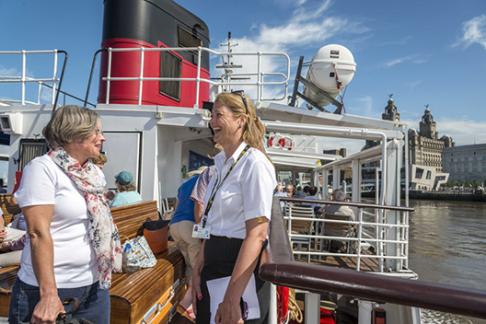
Mersey Ferries - River Cruise + Spaceport
OverView
Helicopter Flight Services - The Ultimate Tour + 9/11 Memorial Museum
New York Helicopter Tour: Helicopter Flight Services is proud to operate top-of-the-line, high-performance Bell407 (up to 6 pax) and EC130 (up to 7 pax) helicopters. The spacious cabins and high visibility windows have been specially designed for sightseeing which allows 180 degree views; no other helicopter operator in New York City can offer these unobstructed views. The Bell and EC130 have proven to be safe, fast and powerful helicopters giving an incredibly smooth ride in virtually all conditions. Pilots are specially trained on both types of helicopters and the state-of-the-art safety system, TCAS. TCAS is an onboard radar system that allows pilots the advantage of managing the air traffic around them. All passengers enjoy their flight with voice interactive headsets to hear and speak to the pilot and each other. 9/11 Memorial Museum: The National September 11 Memorial Museum serves as the country’s principal institution for examining the implications of the events of 9/11, documenting the impact of those events and exploring the continuing significance of September 11, 2001. The Museum’s 110,000 square feet of exhibition space is located within the archaeological heart of the World Trade Center site—telling the story of 9/11 through multimedia displays, archives, narratives and a collection of monumental and authentic artifacts. The lives of every victim of the 2001 and 1993 attacks will be commemorated as visitors have the opportunity to learn about the men, women, and children who died. Visitors to the Museum descend a gently sloped ramp as they make their way to the original foundation level, where the main exhibition space is located. The descent echoes the construction ramps used to build the original World Trade Center, which were placed again at the site in the aftermath of the attacks for removal of debris and to provide access for victims’ family members and others on the anniversaries of 9/11. As visitors make their final descent to the exhibition level, they will pass alongside the Vesey Street stair remnant, the historic "Survivors' Stairs." On 9/11, hundreds escaped with their lives, fleeing down this stairway. Visitors will also see the remnants of structural columns that now delineate the footprints of the original Twin Towers. The mission of the 9/11 Memorial Museum, located at the World Trade Center site, is to bear solemn witness to the terrorist attacks of September 11, 2001 and February 26, 1993. The Museum honors the nearly 3,000 victims of these attacks and all those who risked their lives to save others. It further recognizes the thousands who survived and all who demonstrated extraordinary compassion in the aftermath. Demonstrating the consequences of terrorism on individual lives and its impact on communities at the local, national, and international levels, the Museum attests to the triumph of human dignity over human depravity and affirms an unwavering commitment to the fundamental value of human life. EXHIBITIONS AND EDUCATION CENTER Memorial Hall is situated between the Twin Tower footprints and features a quote forged from remnant World Trade Center steel and a site-specific art installation, Trying to Remember the Color of the Sky on That September Morning. In Memoriam is a quiet, contemplative space that invites you to honor and to learn more about each of the 2,983 people killed in the September 11, 2001 and February 26, 1993 attacks. September 11, 2001 is the main historical exhibition, comprised of three parts that explore the day of 9/11, what led up to the attacks, and the immediate aftermath. Tribute Walk presents a variety of artistic expressions created in response to 9/11. South Tower Gallery features the immersive media experience Rebirth at Ground Zero, which used time-lapse footage and recorded interviews to capture the transformation and renewal of the World Trade Center site. Run time: 11 mins. South Tower Excavation reveals the steel box column remnants that anchored the Twin Towers to bedrock. It is alongside an exhibition about the original construction of the World Trade Center. Center Passage demonstrates the scale of the 9/11 attacks through the monumental aritfacts, evoking the magnitude of the World Trade Center buildings and their destruction. Foundation Hall contains remnants of the original World Trade Center, including the slurry wall and the celebrate Last Column. Reflecting on 9/11 is an ongoing media installation that tracks personal reflections about 9/11 by government officials, historians, 9/ survivors, family members of victims, journalists, and Museum visitors. Recording Studio allows you to add your voice to the Museum exhibitions. Record where you were on 9/11, a remembrance of a victim, or a response to a question posed in Reflecting on 9/11. Film Features - Offered daily and free to Museum visitors. Located in Auditorium, Museum Pavilion L-2 Level "Facing Crisis: America Under Attack" Key 9/11 decision makers describe the events of the day. Features original interviews with President George W. Bush, New York Gov. George Pataki, New York City Mayor Rudolph Giuliani, among others. Screened exclusively at the 9/11 Memorial Museum. "Facing Crisis: A Changed World" World leaders examine 9/11’s impact on global events. Features original interviews with President George W. Bush, British Prime Minister Tony Blair, and Pakistani President Pervez Musharraf, among others. Screened exclusively at the 9/11 Memorial Museum. "Rebirth at Ground Zero" This multi-screen film experience uses time-lapse footage and recorded interviews to present an inspiring first-hand perspective of the transformation and renewal of the World Trade Center site and the uplifting personal journeys of some of those most directly affected by the attacks. Located at Rebirth at Ground Zero, Exhibitions and Education Center (South) C-4 Level Live Talks - Free to Museum visitors. Located at the Auditorium, Museum Pavilion L-2 Level "The Stories They Tell" 9/11 Memorial staff share behind-the-scenes stories about the Memorial and Museum, and its collections. Schedule: Offered Monday through Friday at 12 p.m. Approximately 30 minutes. "We Were There" Personal stories of remembrance and resilience presented by the 9/11 Tribute Center. Schedule: Offered Tuesdays at 4 p.m. Approximately 30 minutes. "Never forget" was the heartfelt refrain after the World Trade Center attacks on September 11, 2001. And now, 13 years later, the National September 11 Memorial Museum has opened, to memorialize those who lost their lives -- and to ensure, once again, that the world will "never forget." The museum’s power rests, first and foremost, in its location: The 110,000 square feet of exhibition space are within "the archaeological heart of the World Trade Center site." The museum takes visitors underground -- literally. It lies 70 feet below ground, so entering the museum involves descent from the light of the outside into dimly lit depths, which adds to the overall power and pathos of this hallowed ground. A variety of fascinating exhibits reveal the makeup of New York City’s impressive bedrock, like a 450-million-year-old chunk of Manhattan schist, excavated in August 2008. WTC’s architectural grandeur is also showcased via a large-scale model, originally built in 1969 to 1971, which is one of the largest and most detailed WTC presentation models still surviving today. It’s a powerful piece, because it highlights what the World Trade Center was, rather than what became of it. And what became of the WTC is displayed throughout the museum, including the Survivors’ Staircase, which was the last visible remnant of the buildings after the attacks. The stairs served as a critical life route for many to escape, and in 2008, the 58-ton stairway moved to the museum, where it looms today. Visitors can also view a massive twisted piece of "impact steel" -- a portion of the north tower facade that suffered a direct hit from American Airlines Flight 11. One side of the museum encompasses the slurry wall, a retaining wall that was built to keep the Hudson River from flooding the site. But though the museum is filled with massive pieces that bear the scars of tragedy, it’s the small personal objects that are perhaps the most haunting: smudged reading glasses, a pair of heels, a trampled wallet splayed to reveal its contents of coins and credit cards, a flight attendant’s wing lapel. As The New York Times art critic Holland Carter beautifully summed it up: “Infused with lost life, they make the experience of moving through this museum at once theatrical, voyeuristic and devotional.” Above all, the museum is a tribute to the victims, to the survivors -- and to their loved ones. Numerous exhibits feature photographs, audio, videotapes and recorded testimonies connected to September 11, 2001 and also to the February 26, 1993, WTC bombing. In many ways, the museum is as much about the WTC’s demise as it is about New York City’s resilience. This is especially evident above ground, at the sun-washed memorial, where parapets engraved with the 2,983 victims’ names surround the twin Memorial pools, which shimmer in the footprints of the Twin Towers. Here, beauty has taken the place of tragedy. Did you know? President Barack Obama, along with September 11 survivors, rescuers and victims’ relatives, were all present during the opening dedication ceremony of the museum in May 2014. Joining Mr. Obama for a tour of the museum were former President Bill Clinton and former Secretary of State Hillary Rodham Clinton. The World Trade Center (WTC) was much more than just a few buildings. The complex consisted of seven structures, covering 16 acres, and included offices, the Windows on the World restaurant, and an underground shopping mall. Roughly 50,000 people worked at the WTC complex, while 40,000 passed through daily. The numbers behind the National September 11 Memorial Museum are impressive: The museum has more than 10,000 artifacts, 23,000 still images and 500 hours of film and video. ACCESSIBILITY The Museum welcomes all visitors. The facility is wheelchair accessible. Manual wheelchairs are available, free of charge on a first-come, first served basis at the coat check on the Concourse Lobby level. Induction loops are installed throughout the Museum, including in the exhibitions, auditorium, and classrooms. Open captioning or written transcripts are available for all exhibition media installations that feature audio. Sign Language interpretation is available, free of charge, for guided tours and public programs by request with two weeks advance notice. The 9/11 Museum Audio Guide is VoiceOver compatible on all iOS devices and includes a descriptive tour for visitors who are blind or partially sighted. Large print materials are available upon request at the Information Desk. Service dogs are welcome. AVAILABLE TOUR LANGUAGES: Sign Language, Spanish, German, Italian, Japanese, Chinese, French and Portuguese
Sac de rangement à suspendre devant Scooter à panier avant Front Pro
Portefeuille de Voyage Organisateur de documents Porte Carte Antivol Blocage RFID Usage quotidien Sécurité Cuir véritable Classique Rétro Cadeau Pour Homme Femme 13102 cm
Catégorie:Porte Carte,Organisateur de documents,Portefeuille de Voyage; Pour:Homme,Femme; Activité:Usage quotidien,Sécurité; Fonction Première:Portable; Matériau:Cuir véritable; Dimensions:13102; Tranche d'Age:Adultes; Fonction:Blocage RFID,Antivol; Motif:Classique,Rétro; date d'inscription:10/21/2020; Mode de production:approvisionnement externe
Coliseo de Roma – Roma en 1 Día – Coliseo + Vaticano
Sitios que se visitan:
Coliseo
Museos del Vaticano
Basílica de San Pedro (opcional)
Capitolio con vistas al Foro Romano
Panteó
Piazza Navona
Fontana di Trevi
Incluye:
Entrada Express al Colireo, los Museos del Vaticano y la Basílica de San Pedro
Transporte entre los diferentes sitios en taxi o autobús
Helado casero gratuito
Guías locales expertos
Excluye:
Propinas
Información importante:
Hay una nueva regla en el Coliseo, el Foro Romano y el Monte Palatino que sólo permite la entrada de mochilas pequeñas y bolsas de mano de tamaño regular en el interior. Los clientes con bolas más grandes o maletas no podrán entrar con estas y tampoco hay taquillas para guardarlo. Recuerde que todos los visitantes deberán pasar por un control de seguridad antes de entrar al Coliseo.
El Coliseo ha cambiado la política de admisión para garantizar un máximo de 3.000 personas en su interior, de manera que habrá menos multitudes durante las horas de máxima afluencia. A pesar de que las entradas exprés para ahorrarse colas son reservadas con antelación, puede haber un poco de retraso en la hora de entrada si el lugar ya ha alcanzado su capacidad máxima en ese momento.
Este tour combina dos opciones diferentes que tenemos: "Lo mejor de Roma – Coliseo y Lugares de Interés" junto a nuestro tour por la tarde llamado "Lugares de Interés del Vaticano – Museos y Capilla Sixtina del Vaticano". También incluye un helado casero y transporte en taxi o autobús desde el centro de la ciudad hasta el Vaticano. ¡Todo junto por un mejor precio que si lo compra por separado!
La Basílica de San Pedro y la Capilla Sixtina son lugares sagrados y, por tanto, la vestimenta debe ser apropiada para la visita. Se les pide a ambos hombres y mujeres que usen ropa que cubra al menos los hombros y las rodillas. Tours Guiados por el Vaticano no se hace responsable de la entrada negada pop una vestimenta impropia.
Su recorrido terminará en la Basílica de San Pedro, donde tendrá entrada exprés para ahorrarse colas, aunque no hay una explicación guiada por el interior de la iglesia.
Asegúrese de que todos los miembros de su grupo llevan una identificación válida el día de la visita. Importante en visitantes que cuentan como estudiantes, niños o jubilados.
TENGA EN CUENTA: todos los Museos del Vaticano están equipados con ascensores para el acceso en silla de ruedas, aunque no están convenientemente ubicados en el recorrido de las visitas guiadas y sólo permiten el acceso a lugares específicos de los museos.